The Secret Deal
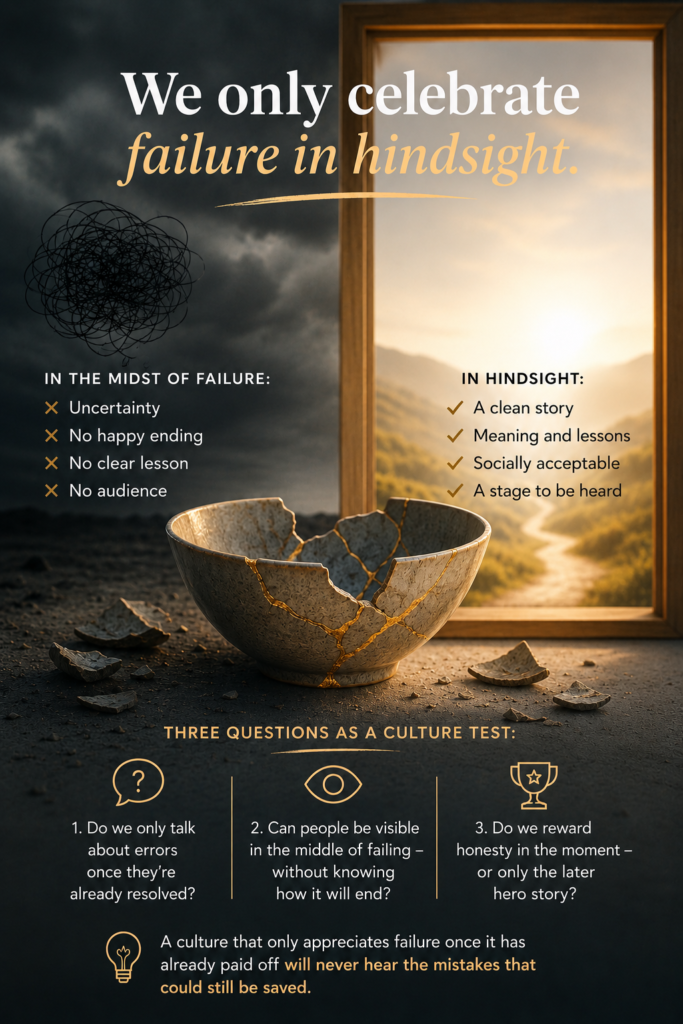
Fuckup Nights, memoirs about the dark years, the TED Talk about bankruptcy before the comeback: Failure has become socially acceptable—as long as we already know how it ends. As soon as the outcome is uncertain, a completely different rule applies to the same mistake.
The Narrative Trap
Nassim Taleb calls this the “narrative fallacy”: In hindsight, we shape every chaotic, uncertain course of events into a neat story with meaning and a lesson. This only works with knowledge that those involved did not have at the time. Added to this is a simple survivorship bias: We hear the stories of those whose failures led to success. Those who are still mired in their mistakes, with no happy ending in sight, have no stage—and usually no audience either.
The result is an unspoken agreement: mistakes can be discussed, but only as part of the past, framed as a learning experience. We’ve already touched on this twice in this series—gossip creates uncertainty because we know how people talk about those who aren’t there; when we don’t forgive, a mistake becomes a permanent record. Here lies the third, and perhaps most uncomfortable, variation: we tolerate failure only when we already know its significance.
The Real Test of Psychological Safety
Amy Edmondson’s concept of psychological safety is often misunderstood as simply being about being allowed to discuss mistakes after the fact. The real test is something else: Is someone allowed to be visible in the midst of failure—with no guarantee of success, and without knowing in the end whether their courage paid off? Teams that only want to hear curated success stories learn too late, structurally speaking. The moment when correction is still possible is precisely the moment that no one shows.
Three Questions as a culture test
- Do we only talk about mistakes once they've long since been resolved?
- Are people allowed to be seen here in the midst of failure—without knowing how it will end?
- Do we reward honesty in the moment—or just the heroic story that comes later?
Conclusion
A culture that only appreciates failure once it has already paid off will never hear about the mistakes that could still be fixed. When was the last time you spoke openly about an unresolved problem—not just after it turned out well?