Why We Feel Losses More Acutely Than Gains: The Negativity Bias in Economically Difficult Times
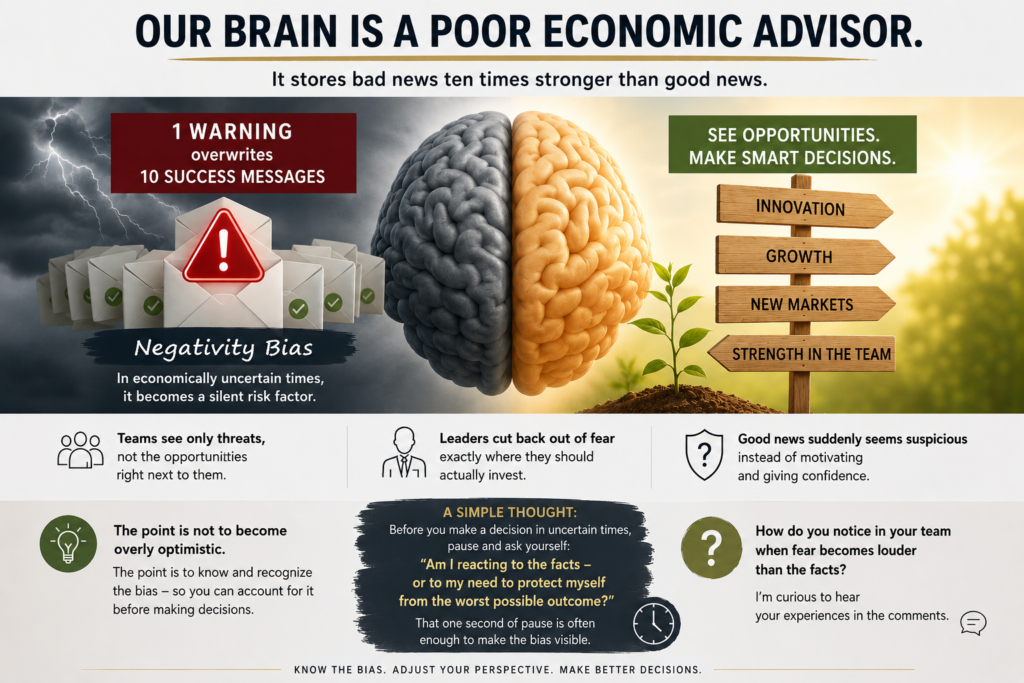
Bad news carries more psychological weight than good news—even if both are objectively equally significant. This phenomenon is called the negativity bias and is one of the best-documented patterns in cognitive psychology. Especially during times of economic strain, understanding this bias determines whether organizations act wisely or out of fear.
What the Research Shows
The seminal work was conducted by Roy Baumeister and his colleagues. In their review article “Bad Is Stronger Than Good,” published in 2001 in the *Review of General Psychology*, they analyzed studies in the fields of emotion, memory, relationships, and learning and arrived at a consistent finding: Negative events, negative feedback, and negative information have a stronger impact across nearly all areas of life examined than their positive counterparts of equal intensity. Negative impressions form more quickly and are more resistant to correction than positive ones; a single point of criticism can outweigh several pieces of positive feedback.
This asymmetry is not merely a quirk of the adult mind. In 2008, Vaish, Grossmann, and Woodward demonstrated in *Psychological Bulletin* that negativity bias can be detected as early as the first year of life—infants react measurably more strongly to negative stimuli than to positive ones. This suggests an evolutionary origin: Those who reliably recognized dangers were more likely to survive and passed on this responsiveness. Those who overlooked an opportunity usually lost little; those who overlooked a threat could lose everything.
Neuroscientific studies support this mechanism at the level of brain activity. The amygdala responds to negative stimuli more quickly and intensely than to positive ones, often within a few milliseconds and even before conscious processing begins. Negative information is also processed in a more elaborate manner and leaves stronger memory traces than comparable positive information.
Der ökonomische Zwilling: Verlustaversion
At the same time, Daniel Kahneman and Amos Tversky developed Prospect Theory, a model of human decision-making introduced in 1979, which earned them the Nobel Prize in Economics in 2002. Their central finding: Losses hurt psychologically about twice as much as gains of the same magnitude bring joy. This loss aversion explains a range of economic behavioral patterns—from the endowment effect and status quo bias to the irrational clinging to bad decisions (sunk cost effect). Loss aversion is closely related to negativity bias, but not identical to it: While negativity bias describes the general overemphasis on negative information, loss aversion specifically refers to the asymmetric evaluation of losses relative to gains.
Warum das in der Wirtschaftskrise besonders wirkt
In konjunkturell schwierigen Phasen verstärken sich diese Effekte gegenseitig – und werden durch die mediale Berichterstattung zusätzlich verstärkt. Eine Studie von Soroka, Daku, Hiaeshutter-Rice, Guggenheim und Pasek (2018, International Journal of Press/Politics) zeigt, dass sowohl traditionelle als auch soziale Medien systematisch negativer über Wirtschaftsthemen berichten als der zugrunde liegende ökonomische Befund es nahelegen würde. Auch eine Analyse der Federal Reserve kommt zu dem Schluss, dass schlechte Wirtschaftsnachrichten einen deutlich höheren Informationsgehalt für die Erwartungsbildung der Menschen haben als gute – der Konsumklimaindex reagiert stärker und schneller auf negative als auf positive Nachrichtenlage.
For organizations, this means that during economic downturns, an already distorted human perception collides with an information environment that is structurally driven by negativity. The result is often a perception that is more pessimistic than the actual situation—with concrete consequences for decision-making: risks are overestimated, opportunities are overlooked, investments are cut prematurely, and, paradoxically, good news comes across as warning signs because it does not fit the expected pattern.
What this means in practice
This bias cannot be eliminated—it is an inherent feature of human information processing. What can be changed, however, is how we deal with it. Here are three approaches that can be derived from research:
First, explicitly separate decisions from emotional reactions. Because negative information is automatically given greater weight, it helps to consciously double-check: Is this assessment based on data or on the emotional impact of the news?
Second, actively counterbalance negative information with positive information—don’t just take note of it. Since, according to Baumeister, it takes several positive events to offset one negative one, it’s worthwhile for teams to consciously highlight successes and progress—not for motivational reasons, but to keep the overall perception balanced and realistic.
Third, take a break from the media and critically evaluate your sources of information. If news outlets consistently report in a more negative light than the facts warrant, executives should base their assessment of the situation on primary data rather than on the tone of the news coverage.
Conclusion
Negativity bias makes evolutionary sense and has been exceptionally well replicated in research. The problem lies not in its existence, but in its invisibility. Those who are aware of it can factor it into their decision-making processes rather than being unconsciously influenced by it—especially when economic pressures further amplify it.

Quellen
Baumeister, R. F., Bratslavsky, E., Finkenauer, C., & Vohs, K. D. (2001). Bad is stronger than good. Review of General Psychology, 5(4), 323–370. https://journals.sagepub.com/doi/abs/10.1037/1089-2680.5.4.323
Vaish, A., Grossmann, T., & Woodward, A. (2008). Not all emotions are created equal: The negativity bias in social-emotional development. Psychological Bulletin, 134(3), 383–403. https://pmc.ncbi.nlm.nih.gov/articles/PMC3652533/
Kahneman, D., & Tversky, A. (1979). Prospect theory: An analysis of decision under risk. Econometrica, 47(2), 263–291. Zusammenfassung: https://en.wikipedia.org/wiki/Prospect_theory
Soroka, S., Daku, M., Hiaeshutter-Rice, D., Guggenheim, L., & Pasek, J. (2018). Negativity and positivity biases in economic news coverage: Traditional versus social media. The International Journal of Press/Politics, 23(3). https://journals.sagepub.com/doi/abs/10.1177/0093650217725870
Federal Reserve Board (2023). Bad News, Good News: Coverage and Response to Economic News. https://www.federalreserve.gov/econres/feds/files/2023001pap.pdf
Brookings Institution. Is the economic news becoming more negative, and does it matter for consumers? https://www.brookings.edu/articles/is-the-economic-news-becoming-more-negative-and-does-it-matter-for-consumers/