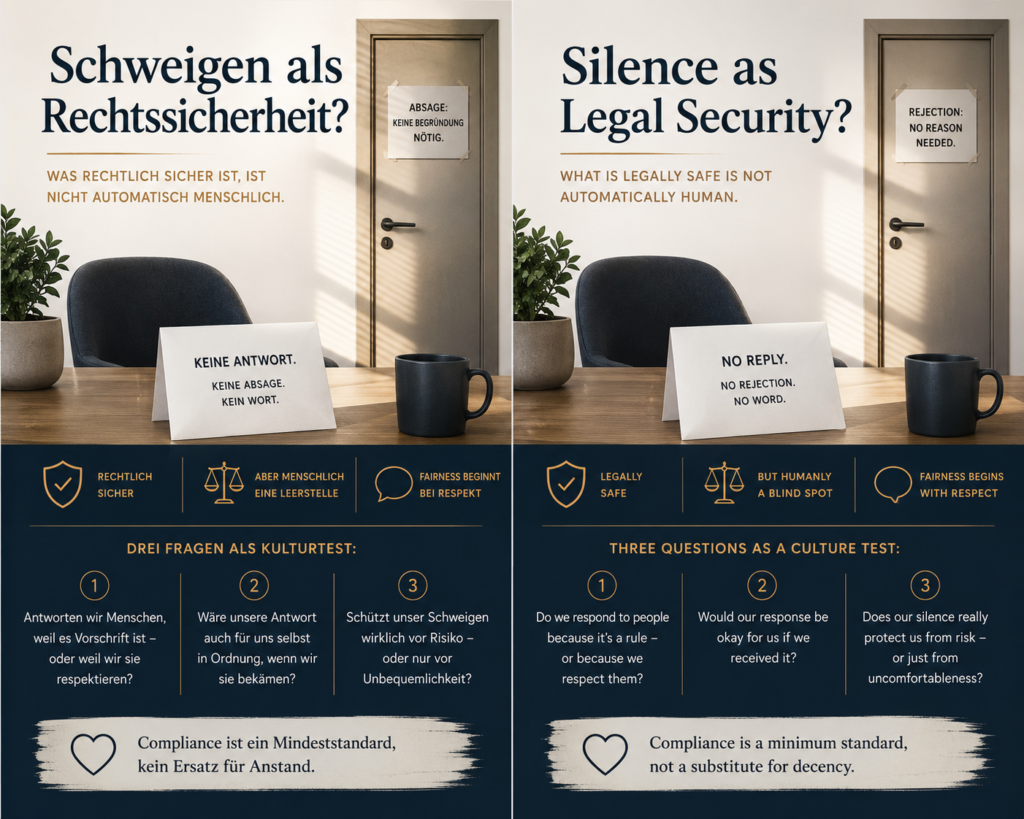
Weeks of Silence
A job application, weeks of silence—eventually, you give up hope. No rejection letter, no explanation, not a word. This is rarely due to negligence. Often, it’s a strategy—just the wrong one.
When Silence Becomes a Legal Strategy
Many legal departments advise keeping rejection letters vague or omitting any explanation altogether to minimize the risk of a lawsuit under the AGG for discrimination. Any specific reason could, in case of doubt, be interpreted as evidence. Paradoxically, the legally safest response is therefore: none at all. A law intended to protect people from discrimination thus creates an incentive to stop communicating in a human way altogether.
What Gets Lost in the Process
Organizational research has been describing what gets lost in the process for decades. Bies and Moag coined the term “interactional justice”: People evaluate a decision not only based on the outcome, but also on how respectfully and transparently it was communicated to them. A rejection delivered with honest words can be perceived as fair. Silence never will be—no matter how legally sound it may be.
It’s the same dynamic as in the previous posts in this series, only at the organizational level: Anyone who makes decisions about someone solely internally, without ever speaking to that person directly, is essentially engaging in gossip—except that in this case, the entire company is the absent person about whom decisions are made but with whom no one ever speaks. Legally sound, but a void on a human level.
The Solution: Task-Based Selection
Yet there is a way out—not through cleverer rejection templates, but through a fundamentally different process. Task-based selection processes, in which applicants complete a specific, job-related task, provide a transparent basis for decision-making rather than a vague overall impression. In their widely cited meta-analysis on personnel selection, Schmidt and Hunter demonstrated that work samples are among the most valid selection tools available—significantly more meaningful than resume screening or gut feelings during an interview. Anyone who can base a decision on whether a task was solved or not doesn’t need to hide behind boilerplate language. Feedback becomes a verifiable fact rather than a legal risk—the hiring process would become both fairer and more honest, and silence would lose its purpose as a shield.
Three Questions as a culture test
- Do we, as human beings, obey the rules because they are mandatory—or because we respect them?
- Would our answer be acceptable to us if we were the ones receiving it?
- Does our silence really protect us from risk—or just from discomfort?
Conclusion
Compliance is a minimum standard; it’s no substitute for decency. Just because you meet the one doesn’t mean you’ve done the other. How does your company handle people who don’t make it to the next round of interviews—with honest feedback, a boilerplate response, or silence?