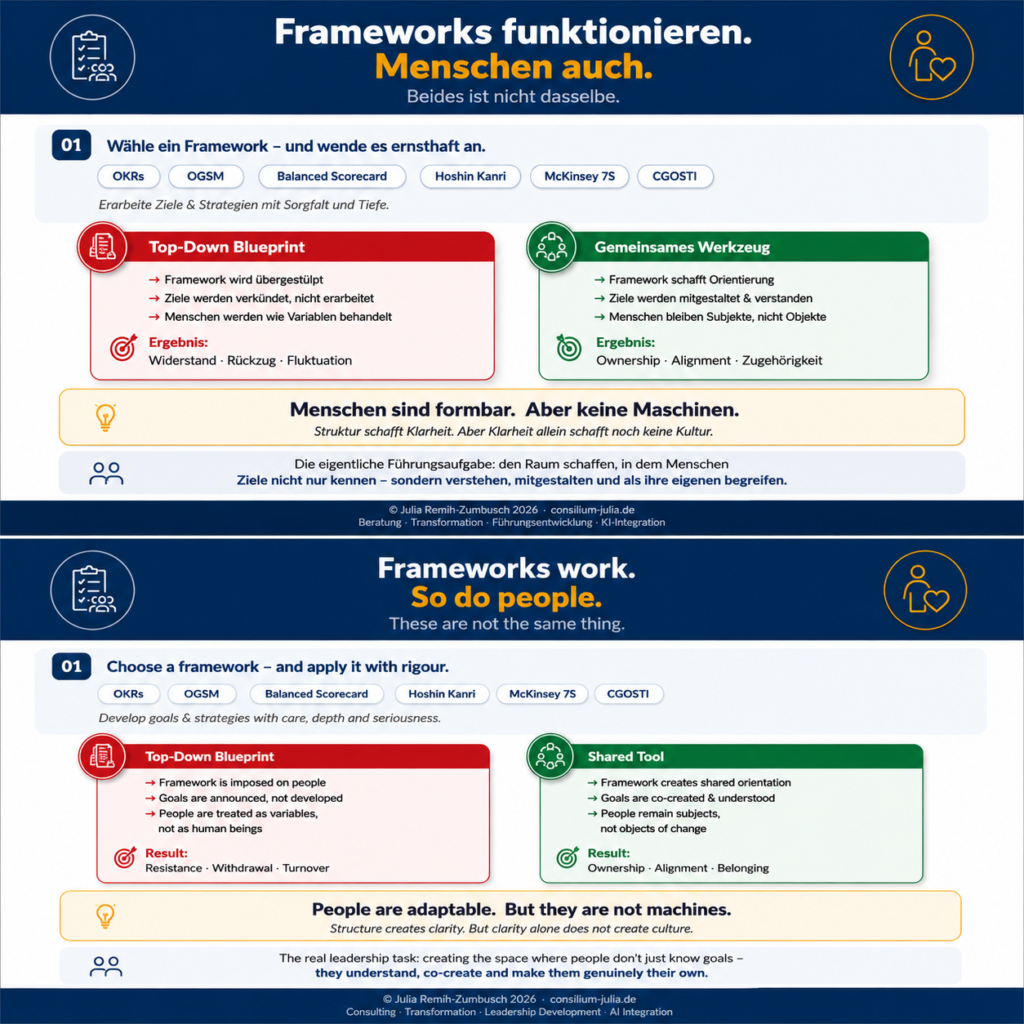
Over the past few weeks, I’ve had several conversations with executives and consultants about structured approaches to strategy development—OKRs, OGSM, the Balanced Scorecard, Hoshin Kanri, McKinsey’s 7S, and, more recently, CGOSTI. The discussions were insightful, and the frameworks were well thought out. And yet, every time, I was overcome by the same feeling: We’re talking about the tool, but not about the hand that wields it.
That led me to write down a thought that I've been experiencing in my practice for years—but rarely express so directly.
Choosing the framework isn't the real challenge.
When companies initiate transformation processes, the discussion almost always begins with the question of methodology. Which framework is right for us? OKRs are popular, but perhaps too heavily influenced by Silicon Valley. The Balanced Scorecard is tried and true, but perhaps too rigid. Hoshin Kanri comes from the world of Lean, OGSM from the consumer goods sector—and CGOSTI is the latest approach that promises to make systems thinking more accessible.
I’m not saying this to downplay these models. They all have their place. They all help to provide clarity: about goals, priorities, responsibilities, and the connection between strategic intent and operational action. Anyone who embarks on a transformation without any structure will fail—there’s no doubt about it.
But here's what I've learned after 15 years in organizational and leadership development: The choice of framework rarely determines success or failure. How it is used, however, does.
Where most transformations really fail
I have guided many transformation projects—in large corporations, medium-sized companies, and public institutions. And the pattern I see time and again is alarmingly consistent: The framework is carefully selected, the strategy is developed, goals are formulated, and workshops are conducted. And then—then the results are presented.
People.
As a finalized document. As a done deal. As a roadmap that must now be followed.
And it is precisely at this moment that the silent failure begins. Not with resistance—that would at least be relatively honest. But with withdrawal. With working strictly by the book. With the employees feeling: Das ist nicht meins. Ich wurde nicht gefragt. Ich soll liefern, nicht gestalten.
What gets lost in the process isn't just motivation. It's the foundation of any lasting change: ownership.
People are adaptable. But machines are not.
People can adapt. They are capable of learning, growing, and changing—if the conditions are right. This isn't some romantic notion, but something I experience every day.
But they don't work like systems where you enter inputs and expect outputs. They need meaning. They need to feel heard. They need the space not only to know their goals, but to understand them—and, ideally, to have helped shape them.
The moment a framework shifts from being a shared tool for orientation to a top-down blueprint is the moment when structure becomes bureaucracy. And when potential creators become mere participants.
This isn't a soft-skills problem. It's a leadership problem.
What good transformation work really means
Choose a framework. Apply it seriously. Invest in developing goals and strategies—with depth, consistency, and methodical care.
And then: Engage with people in this process—don't go over their heads.
That doesn’t mean every decision has to be made by consensus. Leadership also means setting a direction—sometimes even when not everyone agrees right away. But there’s a crucial difference between setting a direction and imposing outcomes; between deciding and dictating; between providing guidance and demanding conformity.
This difference determines whether people see a transformation as something of their own—or as something that happens to them.
Structure creates clarity. But clarity alone does not create a culture.
Ultimately, it’s a simple yet profound insight: Frameworks are tools. Good tools. But tools have no intrinsic value—they only realize their value in the hands of people who use them thoughtfully and in context.
The true role of leadership is not to choose the right framework. It is to create an environment in which people not only know their goals—but also understand them, help shape them, and embrace them as their own.
That's transformation. Everything else is project management.