Yesterday’s discussion focused on judging and gossiping—and on the fact that teams are healthier when conflicts are addressed rather than commented on. But addressing the issue head-on is only half the battle. The other half begins afterward: What do we do with the judgment once it’s been voiced?
Our brains don’t like to forget mistakes. Roy Baumeister demonstrated this with his concept “Bad is stronger than good”: Negative information carries significantly more weight in our memories than positive information. A single slip-up overshadows ten reliable contributions. The colleague who once missed a deadline remains “the one who made the mistake”—long after the issue has been resolved.
Here, we fall into the same line of reasoning as when we gossip: the fundamental attribution error. Once we’ve formed a judgment about someone, we view their future behavior through that lens. We notice what confirms our view and overlook what contradicts it. A single observation turns into a lasting suspicion.
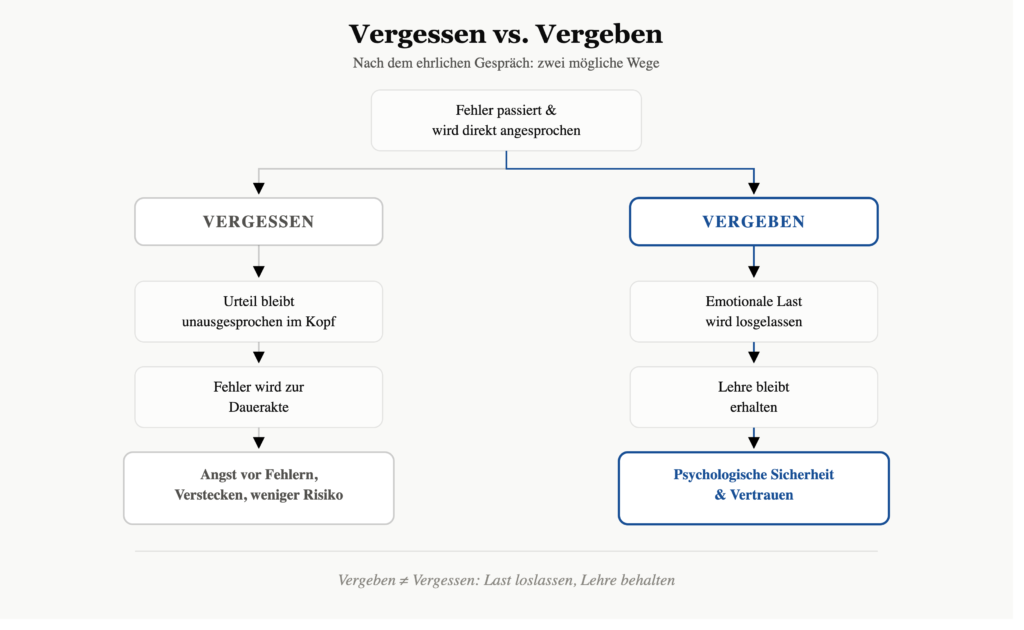
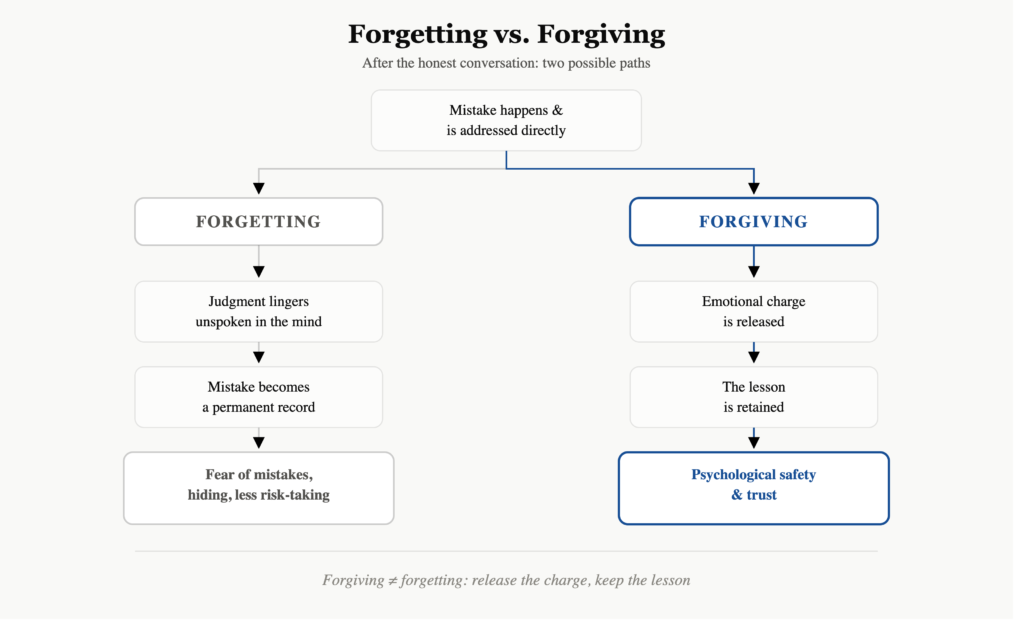
Forgiving does not mean forgetting. Forgetting is synonymous with erasure. Forgiving releases the emotional burden—while retaining the lessons learned. Kim Cameron’s research on organizational resilience also shows that teams that actively remain “forgiving” after mistakes or crises recover more quickly and take more risks because no one has to fear being reduced to a single moment.
And that is exactly the price we pay when we don’t forgive: When people know that a mistake will become a permanent record, they stop taking risks, admitting mistakes, and showing vulnerability. The psychological safety that we discussed yesterday as a key factor in team performance isn’t just destroyed by gossip—it’s also destroyed by never-ending reminders.
In VUCA-defined times—or, to put it another way, in a BANI world—where uncertainty and mistakes inevitably become more frequent, a team’s ability to forgive quickly rather than hold a grudge for a long time determines whether crises lead to shared learning or to blame and stagnation.
Three questions as a culture test:
Do we still talk about someone as “the one who back then…”—or do we see that person in the here and now?
Has the matter been resolved—or are we just quietly carrying it with us?
Are we confusing holding a grudge with taking responsibility?
Honesty without forgiveness only creates a record of suspicions. It is only when both are combined—openly addressing issues and then truly letting them go—that a team becomes trustworthy.