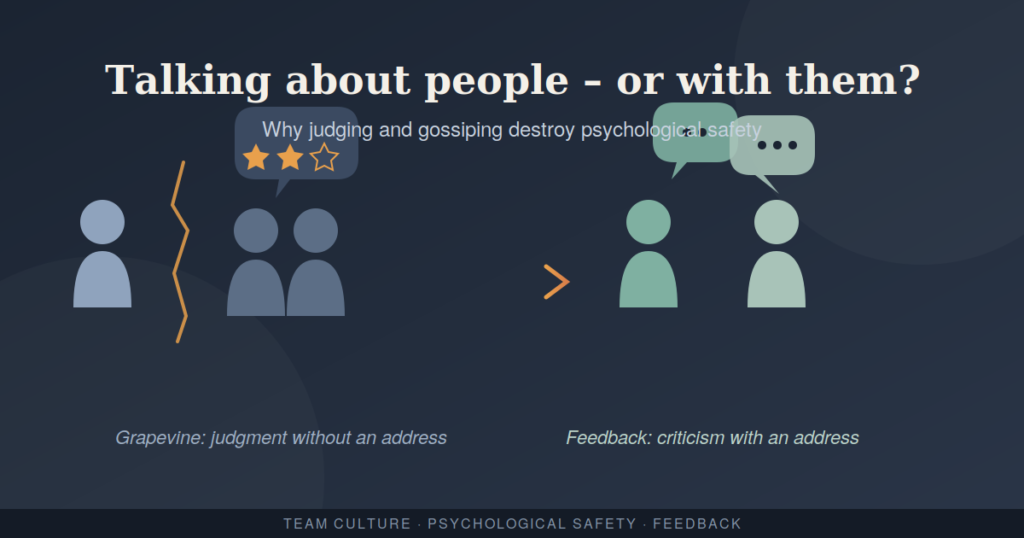
Gossip is often seen as a harmless outlet. Research paints a more nuanced picture—and an uncomfortable one.
What really happens here. From an evolutionary psychology perspective, gossip is a social glue: According to Robin Dunbar, it serves as a means of exchanging information about norms and reputation. But this is precisely where the downside lies. Anyone who regularly evaluates colleagues who are absent from the team sends an implicit message to everyone present: This is how people talk about you when you leave the room.
The price: psychological safety. Amy Edmondson (Harvard) has shown that psychological safety—the shared belief that team members can ask questions, admit mistakes, and disagree without fear of embarrassment—is the strongest predictor of team performance. Google’s Project Aristotle reached the same conclusion. A culture of judgment and gossip undermines precisely this sense of safety. The result: people stop being themselves, mistakes are hidden, and learning doesn’t take place.
Why We Judge Anyway. Our brains love quick assessments. The fundamental attribution error leads us to attribute others’ behavior to their character (“He’s unreliable”)—while we blame our own behavior on circumstances (“I just had too much on my plate”). This makes gossip feel like analysis, but it’s usually just bias played out in front of an audience.
The difference that matters. Research on “prosocial gossip” (Feinberg et al., Stanford) shows that talking about behavior to uphold norms or warn others can actually promote cooperation. The difference lies in the intention and the target audience. Criticism that never reaches the person concerned—but instead circulates only through the grapevine—changes nothing—except the climate of trust.
Three questions as a culture test:
1. Are we talking to people or about them?
2. Would I say the same thing if that person were in the room?
3. Does my review help find a solution—or is it just to boost my status?
Teams that address conflicts rather than just commenting on them aren't necessarily more harmonious, but they are more honest and, in the long run, significantly more effective.