Recently, someone left an ironic comment under one of my posts, saying that what I write might be new to AI—but not to intellectuals and people.
I smiled briefly. And then I thought: Exactly.
That's not what I'm talking about.
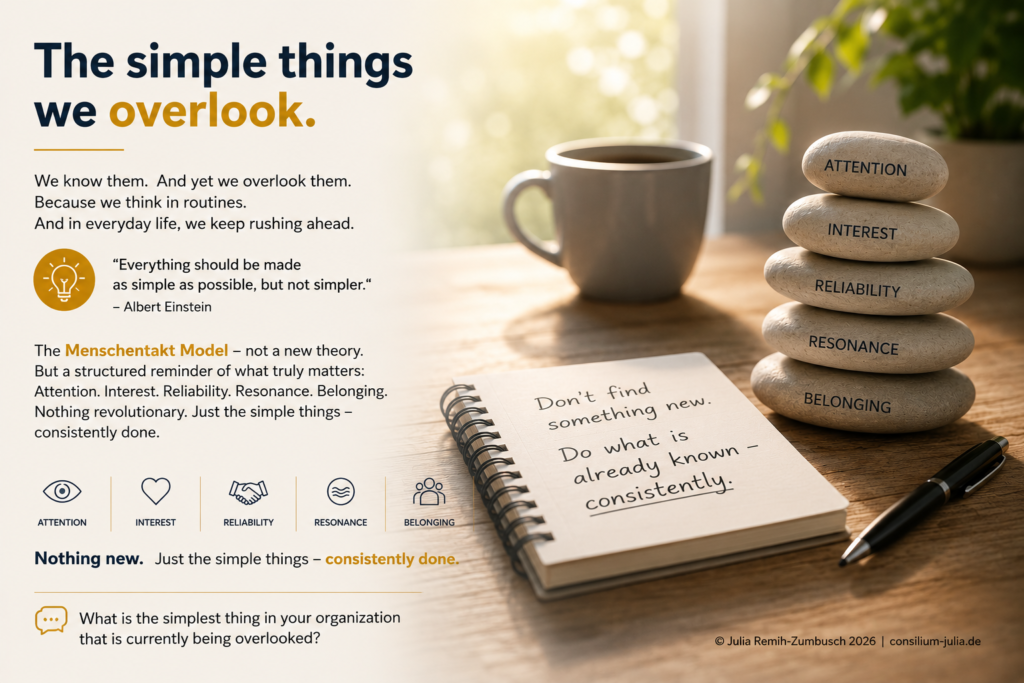
Albert Einstein is said to have once said:
“You should make everything as simple as possible, but not simpler.”
I'm not reinventing the wheel. Quite the opposite.
What drives me is something else: The simple things are so simple that we constantly overlook them in our daily lives. Not because we don’t know them—but because we are creatures of habit. We think in patterns, act on routines, and just when it would be important to pause, we keep racing ahead.
I’ll admit it: At the beginning of my career as a consultant, I often felt like a charlatan. Like someone who wasn’t really selling any special secrets—because it always came down to the same things. Attention. Genuine interest. Reliability. That moment when someone feels: I belong here. I’m seen.
These aren't revolutionary concepts. We all know that.
Und trotzdem – schauen wir uns an, wie Onboarding oder Projekte oft laufen. Wie Transformationen scheitern. Wie Menschen in Organisationen unsichtbar werden, obwohl sie täglich anwesend sind.
Knowledge does not protect against forgetting. And forgetting does not protect against consequences.
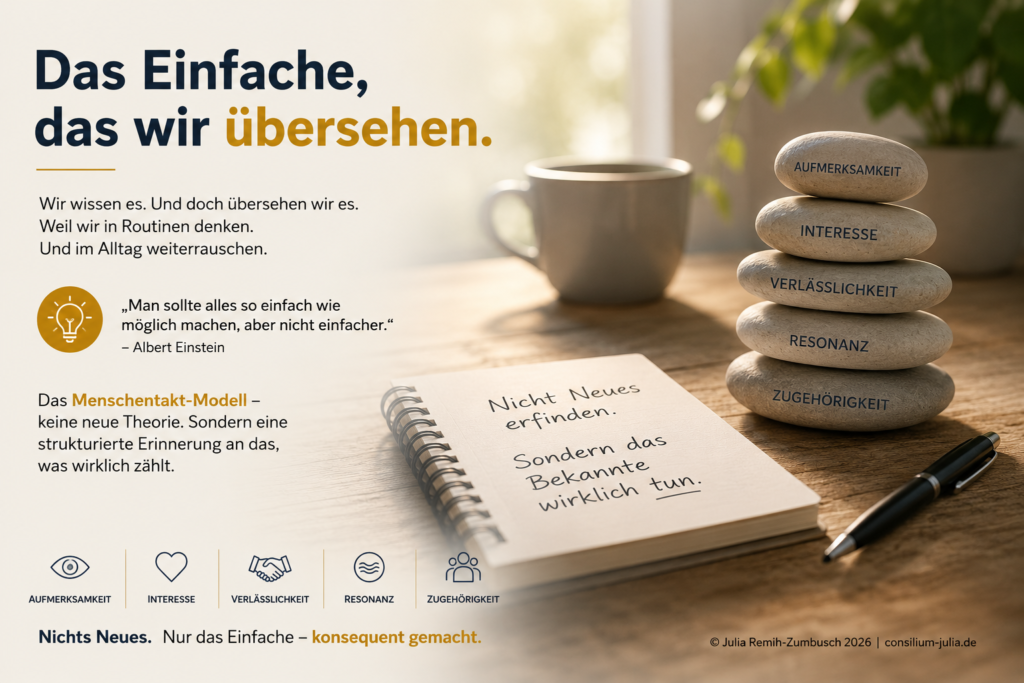
That’s exactly why I developed the Menschentakt Model, among other things—not as a new theory, but as a structured framework. Five dimensions that everyone is actually familiar with: attention, interest, reliability, resonance, and belonging. It’s not rocket science. It’s not uncharted territory.
Just the simple things — done consistently.
Because that is the real challenge: not to invent something new, but to actually do what we already know.